
Electrostatic and centrifugal oil mist collectors use different collection principles. The appropriate choice depends on the machine enclosure, coolant, contaminant mixture, process, maintenance resources and site safety requirements.
Electrostatic vs centrifugal oil mist collectors at a glance
| Consideration | Electrostatic collector | Centrifugal collector |
|---|---|---|
| Primary collection principle | Charges airborne droplets and captures them on oppositely charged collection surfaces. | Uses a rotating stage to coalesce droplets, followed by filtration of the remaining mist. |
| Application review | Requires assessment of mist composition, conductivity, particulate and cleaning requirements. | Requires assessment of enclosure airflow, mist load, coolant, particulate and filter configuration. |
| Maintenance focus | Collection-cell condition, cleanliness and electrical components. | Inlet, drainage path, rotating stage, internal filter and optional post-filter. |
| Selection basis | Neither technology should be selected from efficiency claims alone. Review the complete machine and process conditions. | |
How an electrostatic oil mist collector works
An electrostatic collector applies an electrical charge to airborne droplets and captures them on collection surfaces with the opposite charge. Performance depends on the condition of the collection cells and on compatibility with the mist, particulate and other contaminants produced by the process.
Cell cleaning and electrical inspection form part of the maintenance plan. Conductive contamination, unusual chemicals and mixed emissions require evaluation by qualified personnel before a technology is selected.
How a centrifugal oil mist collector works
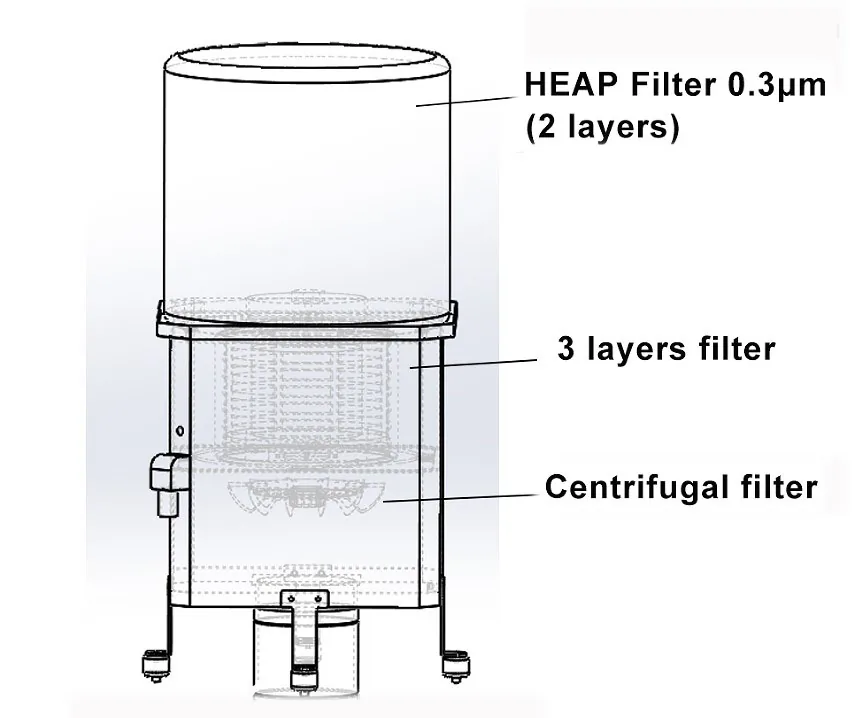
A centrifugal collector draws contaminated air from an enclosed machine tool. A rotating turbine coalesces suspended droplets so separated liquid can move toward the drainage path. The remaining airflow then passes through a multilayer filter.
TINME centrifugal models are intended for enclosed CNC lathes, Swiss-type lathes, machining centers, grinding machines and related equipment. Available configurations should be matched to the enclosure, coolant, mist load, power supply and installation arrangement.
When optional post-filtration may be considered
An optional HEPA post-filter can be considered when the application involves micromist, smoke or vapor and the confirmed configuration requires additional filtration. The supplied TINME specification states performance up to 99.97% at 0.3 micrometers with the optional filter; it does not state an H13 classification.
Questions to answer before choosing a collector
- What machine and process generate the mist?
- Is the coolant neat oil or water-miscible?
- Does the emission include smoke, vapor or significant particulate?
- What are the enclosure dimensions and door-opening pattern?
- What cleaning and maintenance resources are available?
- Are combustible materials, unusual chemicals or other process hazards present?
- What voltage, frequency, mounting space and drainage arrangement are available?
Which technology is better for a CNC machine?
There is no universal answer. The better technology is the one that is compatible with the actual contaminant, maintains effective enclosure capture and can be inspected and maintained correctly at the site. Generic particle-efficiency comparisons do not establish suitability for a specific machine.
Discuss the application with TINME
Review the TINME centrifugal oil mist collector range, read how centrifugal collection works, or send machine and process details for application guidance.
Discuss Your CNC Oil Mist Application
Send the machine type, enclosure size, coolant, operating conditions and available power supply for model-selection support.
Request Application Advice